

Commercial Pest Control: 5 Things to Compare Before Hiring
Hiring pest control commercial services sounds simple until you start comparing quotes. One company promises monthly visits for a low flat rate. Another sends a long contract with vague terms. Meanwhile, a single rodent sighting or a roach in the kitchen can cost you a customer, a health inspection, or a bad review.
Here is the short answer. Compare five things before you sign: the services and pests covered, how often they visit and how they document it, how the price is built, the contract terms, and whether they know your local pests. In the Phoenix area, that last one matters more than most owners expect. Scorpions, roaches, and rodents behave differently here than in other regions.
At Polite Pest Co., we have protected Mesa and Phoenix-area businesses for over a decade. Below, we walk through each point, what to ask, and what a good answer sounds like, so you can choose a provider with confidence and avoid paying for service you do not need.
1. Inspection process and treatment approach
The inspection is where a provider shows you how they think. Everything after it, from the price to the treatment plan, depends on what they find. For commercial pest control , a quick look at the lobby is not enough, because the real problem is usually somewhere you do not see .
What to look for
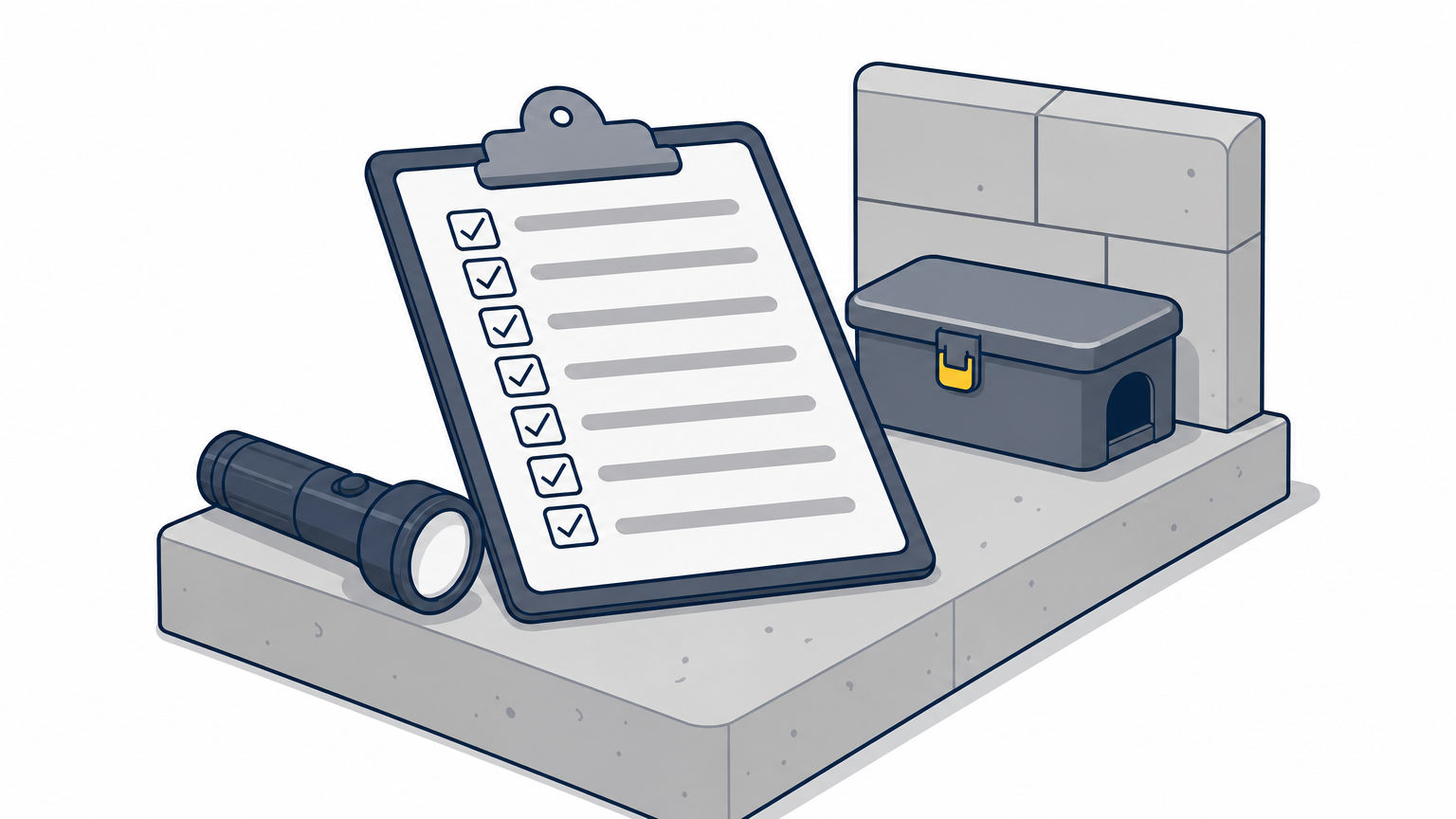
Expect a full walkthrough of your property , inside and out. A good technician checks entry points, moisture sources, storage rooms, dumpsters, and loading docks. In the Phoenix area, that also means block walls, irrigation lines, and door gaps where scorpions slip in. You should leave with a written report and treatment plan , not a verbal summary.
A good inspection finds why pests are getting in, not just which pests are there.
Look for a plan built on exclusion first , with targeted treatments second:
- Sealing gaps, door sweeps, and screen repairs
- Sanitation notes for your staff, such as dumpster and storage habits
- Spot treatments or baits matched to the pest, not blanket spraying
- Monitoring devices with a log you can review
Questions to ask providers
Bring the same short list to every estimate. Asking identical questions lets you compare answers side by side instead of comparing sales pitches:
- Who performs the inspection, and will that technician handle my regular visits?
- What does the report include, and how soon do I get it?
- Which methods do you try first, and when do you use chemicals?
- How do you treat around food, customers, and employees?
Red flags to avoid
Watch for quotes given without a site visit . A price set over the phone means nobody has looked at your building, so expect surprise add-ons later.
Vague treatment language is the other warning sign. If a rep says they will "spray the perimeter" every visit but cannot explain what product, where, and why , you are paying for a routine instead of results .
2. Industry experience and pest knowledge
A restaurant, a medical office, and a warehouse each attract different pests and answer to different rules. That is why experience in your type of business matters as much as years in operation.
What to look for
Start with a provider that has worked with businesses like yours . Ask for references from similar properties and call at least one. A company that handles grocery stores understands food-safety pressure in a way a lawn-and-home specialist may not.
Local knowledge counts just as much. Around Mesa, Chandler, and Scottsdale, that means knowing bark scorpions, German roaches, roof rats, and termites , plus how summer heat and monsoon moisture push them indoors.
A provider who knows your industry and your zip code will catch problems a generalist misses.
Questions to ask providers
Ask for specifics, because real experience shows up in details . These questions work well:
- How many commercial accounts like mine do you service?
- Which pests cause the most trouble here, and in which months?
- Can you describe a recurring problem you solved for a similar business?
- How are your technicians trained, and how often?
Red flags to avoid
Be wary of a rep who says every building gets the same treatment. Generic answers suggest a script, not knowledge of your property or your pests.
Skip any company that cannot name a single commercial client or reference. Without proof, you are the test case , and your customers see the results.
3. Licensing, safety and compliance support
Licensing is not paperwork for its own sake. When a technician applies product inside your building, your business shares the risk if something goes wrong. A good provider also helps you pass inspections and audits , which matters if you serve food or care for patients.
What to look for
Ask for a current Arizona pest control license and proof of liability insurance . You can verify the license with the Arizona Office of Pest Management before you sign.
A licensed, insured provider protects your business, your staff, and your customers.
Compliance support should also include:
- Written service reports after every visit
- Safety data sheets for each product used
- A pest logbook ready for inspectors
- Advance notice before treatments in sensitive areas
Questions to ask providers
Put these to every company you compare:
- Are your technicians individually licensed or certified?
- What insurance do you carry, and can I see the certificate?
- Will you keep documentation ready for health or third-party audits?
- What happens if a treatment affects an employee or customer?
Red flags to avoid
Hesitation over paperwork says a lot. A rep who dodges the license question or hands you a certificate that has expired is showing you how the rest of the business runs.
Also walk away from companies that will not name the products they use or skip written reports. Without records, you cannot prove your pest program to an inspector, and you are left defending a service you cannot document.
4. Service plans, pricing and contract terms
Price is the first thing owners compare and the last thing that tells you much. When you line up pest control commercial quotes , compare what each one includes, not just the monthly number .
What to look for
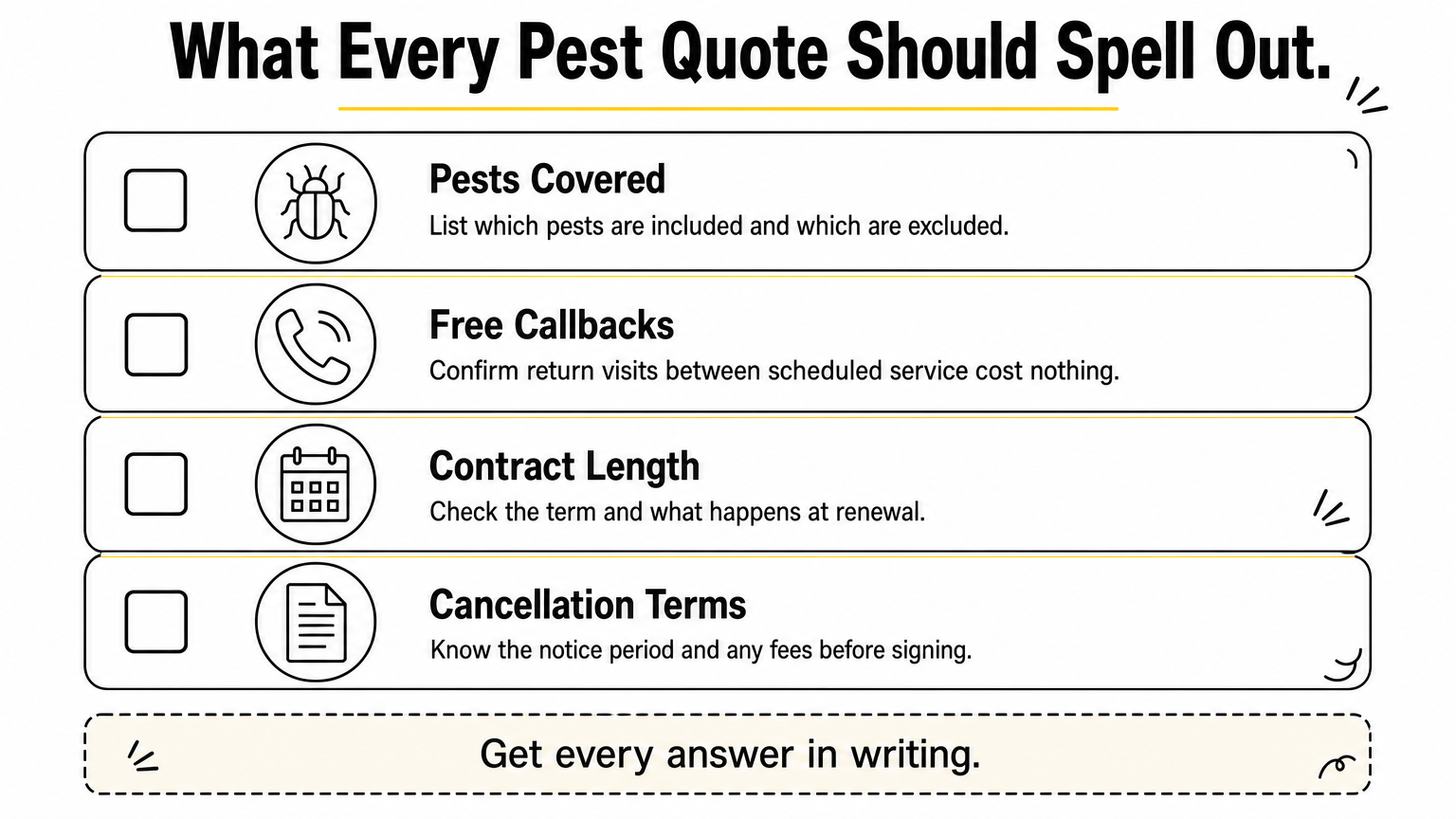
Good pricing reflects property size, pest pressure, and visit frequency . Most businesses do best on a monthly or bimonthly plan , because one-time treatments rarely fix a recurring problem. Check that each quote spells out:
- Pests covered and pests excluded
- Free callbacks between scheduled visits
- Length of the contract and renewal terms
- Cancellation notice and any fees
The cheapest quote is rarely the lowest cost once add-ons and callbacks are counted.
Questions to ask providers
Get every answer in writing , because verbal promises disappear at renewal time. Ask each company:
- Is my rate fixed for the full term, or can it rise at renewal?
- What happens if pests return between visits?
- Can I cancel with 30 days' notice, and is there a fee?
- Do you give a free estimate after an on-site visit?
Red flags to avoid
Beware of auto-renewing contracts with steep cancellation fees. They lock you in even when service slips.
A rock-bottom price with no itemized scope is just as risky. It usually means thin service , such as fewer visits, skipped areas, or charges for every callback.
5. Local response time and communication
Pests do not wait for your next scheduled visit. If a rodent shows up on a Friday before a busy weekend, how fast your provider responds decides whether it stays a small problem or becomes a bad review.
What to look for
Choose a local provider with technicians nearby , because distance affects how quickly someone can reach you. Same-day or next-day callbacks should be standard for commercial pest control accounts, not a premium add-on.
Fast response only helps if your provider also tells you what they found and what happens next.
Good communication usually includes:
- A direct phone or text contact for your account
- Arrival windows and visit reminders
- A service report sent right after each visit
- A clear option for urgent or after-hours problems
Questions to ask providers
Test responsiveness before you sign. Notice how quickly they return your first call, because that is a preview of future service . Then ask:
- How fast do you respond to an urgent call?
- Will I reach a person who knows my account, or a call center?
- Do you regularly service my part of the Phoenix area?
- Do callbacks between scheduled visits cost extra?
Red flags to avoid
Slow replies during the sales process are the biggest warning. A company that takes three days to send a quote will not move faster once it has your signature on a contract .
Missed appointments with no notice are another bad sign. So are technicians who rotate constantly, because you end up re-explaining your building every visit and nobody owns the problem .
Choosing the right provider for your business
The best commercial pest control company is not always the cheapest or the biggest. It is the one that inspects thoroughly, knows your industry and local pests, holds the right licenses, puts fair terms in writing, and answers fast. Score each provider on those five points and the right choice usually becomes obvious.
Your search for pest control commercial help is really a search for a partner. A good one protects your reputation as much as your building, and it shows in the details: clear reports, honest answers , and a technician who knows your property.
If you run a business in Mesa, Chandler, Gilbert, Queen Creek, Phoenix, or Scottsdale, we would be glad to take a look . Request a free, no-obligation estimate for your business from Polite Pest Co. and see what a thorough inspection should feel like.