

Exterminator for Bees near Me: 5 Options and What to Ask
The right exterminator for bees near me depends on where the bees are and what you want to happen to them. A swarm hanging from a branch suits a volunteer beekeeper. A hive inside a wall, roof or meter box needs a licensed company that removes the comb, and a local pest control company such as Polite Pest Co. is the simplest single call. Wasps, hornets and small exposed nests suit a chain that treats them fast.
Most people searching this are watching bees fly in and out of a gap in the yard. They want three answers: who can come, what it costs, and whether the bees will be killed. In the Phoenix area there is a fourth worry. Africanized honey bees are established here, so a colony is never a do-it-yourself job.
Below are five options for Mesa and the East Valley, each broken down the same way. After them come a comparison table, the questions to ask on the phone and what to do while you wait. We run Polite Pest Co. in Mesa, so we list ourselves first and say plainly where another option fits better.
1. Polite Pest Co. bee control
Polite Pest Co. is a local pest control company that removes bees from homes and businesses. It is the easiest choice when you want one local company to look at the problem and give you a price.
How it works and what it costs
Polite Pest Co. offers safe and humane bee removal for residential and commercial properties with a hive on the grounds. You call, describe what you see, and ask for a free, no-obligation estimate . Bee control sits alongside ants, scorpions, rodents and recurring plans, so the same company can follow up on other pests later.
Ask what happens to the bees and the comb before you agree to any price.
Pricing is based on the size of your property, and the estimate costs nothing, so you can set it beside other bids. Ask how your colony will be handled and whether comb and honey are cleared. Those two answers decide whether the problem stays solved.
Who it suits and the catch
This option fits homeowners and business owners in Mesa, Chandler, Gilbert, Queen Creek, Phoenix and Scottsdale who want one local provider for bees and for ongoing pest plans. Businesses that need discreet service with customers nearby fit well too. Polite Pest Co. is a small, family-owned company run by Erick Estrada, with over a decade of pest control experience.
The catch is hours. The office is open Monday to Friday, 8:00AM to 4:00PM at (480) 331-5040, and closed Sundays. For a Sunday emergency you may need a specialist with extended hours. If you only have a resting swarm and want free pickup, a beekeeper is the better call.
2. Local bee removal specialist
A local bee removal specialist is a company that does little else. Pick one when a hive is established in a structure, the bees are acting defensive, or speed matters more than price.
How it works and what it costs
Because bees are the whole business, these crews see wall hives, block-wall voids and Africanized colonies every week. Most offer a choice between extermination and live relocation , and many advertise fast or same-day response . Confirm the arrival window when you book rather than relying on the website.
Specialists earn their fee on the comb, so ask what they do with it.
Structural jobs are usually quoted after a phone description or an inspection. Cost follows access, hive size and how much comb must come out. Ask for the quote in writing with comb removal listed as a line.
Who it suits and the catch
This option suits anyone with an established hive in a wall, attic, soffit or roofline. It also suits anyone whose volunteer beekeeper has already said no.
The catch is that quality varies. Some crews spray and leave, and some never patch the opening. Check the license and insurance , and ask who seals the entry point. A bare cavity invites the next swarm.
3. Live-removal beekeeper
A paid live-removal beekeeper is the right call when you want the colony kept alive and the hive is inside a structure. It is usually the most thorough relocation and often the most expensive.
How it works and what it costs
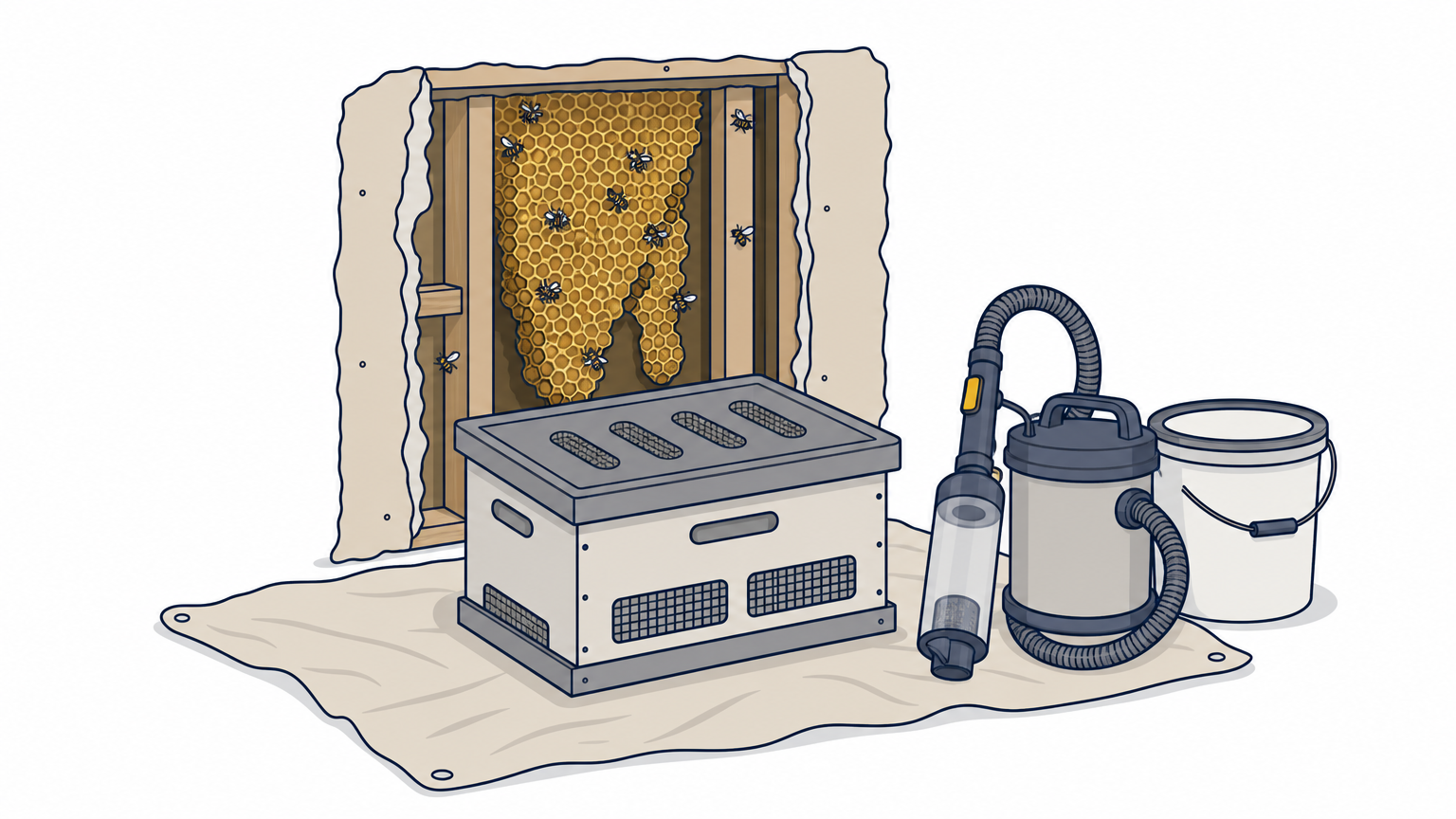
The beekeeper opens the wall, soffit or valve box, vacuums the bees and takes out the entire comb before relocating the colony. Comb removal is the step that matters. In Arizona summer heat, wax and honey left behind melt, stain drywall and attract ants, rodents and later bees.
Removing the bees without the comb only turns a hive into a mess.
Expect a higher price than a swarm pickup, because the work involves labor and opening the structure. Get the quote in writing and ask about insurance, since someone will be working on your roof or wall.
Who it suits and the catch
This fits homeowners who want the bees saved and will pay for it. It also fits cases where the hive sits in a spot that needs careful access.
The catch is that most beekeepers do not do carpentry. Ask who patches and seals the opening and whether that cost is in the quote. Beekeepers may also decline colonies that are very defensive, so be honest about what you have seen.
4. Volunteer beekeeper swarm pickup
A volunteer beekeeper is the best choice for a fresh swarm, and it is often free. This is the gentlest route for the bees and the cheapest for you.

How it works and what it costs
A swarm is a ball of bees clinging to a branch, fence or patio furniture with no comb yet. The bees are resting while scouts look for a home, so a swarm often leaves on its own within days. A beekeeper boxes the cluster and carries it off. Swarm calls peak in spring.
A swarm on an open surface is the one bee problem that often costs nothing to solve.
To find a volunteer, check with the Arizona Apicultural Society or a local beekeeping group for swarm contacts. Call as soon as you spot the cluster. Expect free or a small fee for fuel.
Who it suits and the catch
This suits homeowners with a swarm in a tree, on a fence or against an outdoor wall who can wait a day or so. It does not suit a hive inside a structure or a business with customers walking past.
The catch is control. Volunteers set their own schedule, rarely cut open walls and give no written quote or guarantee . If the bees have already built comb, you are in specialist territory.
5. National pest control chain
A national pest control chain suits you when you want a quick scheduled visit, a written plan and a call center. Expect treatment more than rescue, so this is where an exterminator in the traditional sense lives.
How it works and what it costs
Yes, an exterminator will get rid of bees, but the method is usually a residual insecticide applied to the nest or entry point. That kills the colony quickly. It also leaves the comb in place unless removal is part of the job.
Killing a colony is fast, but a dead hive left in a wall becomes a second problem.
Chains typically quote per visit or fold the job into a recurring plan. Ask whether comb and honey removal is in the price, because a dead colony in a wall still smells and leaks.
Who it suits and the catch
This fits wasps, hornets and small exposed nests, or any case where speed beats saving the bees. It also works if bees are near a door or a busy patio and you need them gone today.
The catch is that many chains do not offer live relocation or wall repair. Confirm that the technician can tell honey bees from wasps at the first visit, because the right treatment differs.
How to compare quotes and handle the wait
Compare the five options on price model, speed and what happens to the bees, then ask the same questions of every bidder. Cheap quotes usually leave something out, most often comb removal or sealing.
Side-by-side comparison
| Option | Cost model | Speed | What happens to the bees | Best for |
|---|---|---|---|---|
| Polite Pest Co. | Free estimate, based on property size | Weekdays, 8:00AM to 4:00PM | Safe, humane removal (confirm method) | Hives on home or business property |
| Bee removal specialist | Written quote, higher for walls | Often fast | Killed or relocated, your choice | Established or defensive hives |
| Live-removal beekeeper | Written quote, highest | Scheduled | Kept alive | Hives in structures |
| Volunteer beekeeper | Free or small fee | Often a day or more | Relocated alive | Swarms on open surfaces |
| National chain | Per visit or plan | Usually quick | Usually treated | Wasps, small exposed nests |
Questions to ask before you hire
Five questions separate a solid bid from a vague one:
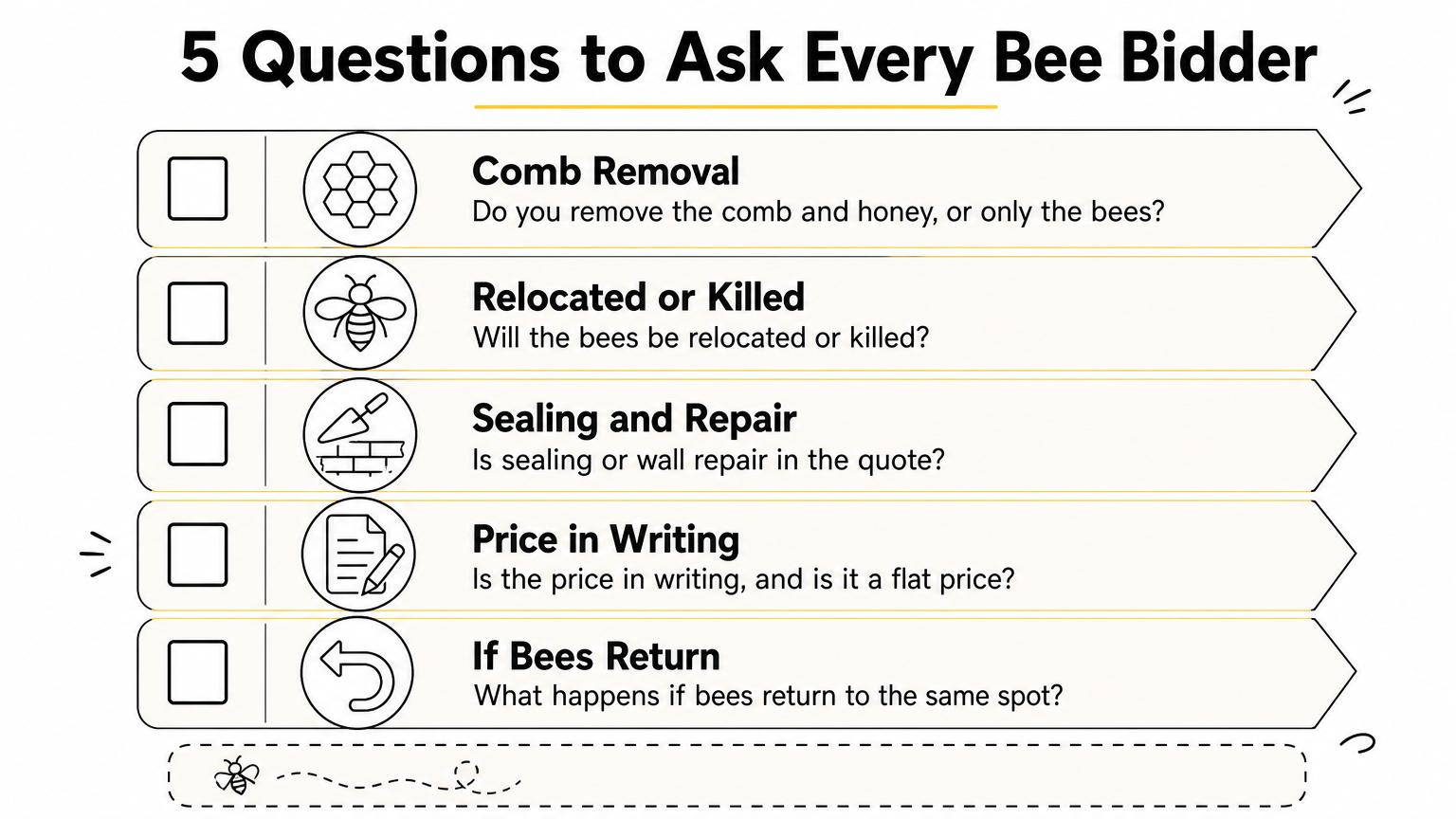
- Do you remove the comb and honey, or only the bees?
- Will the bees be relocated or killed?
- Is sealing or wall repair in the quote?
- Is the price in writing, and is it a flat price?
- What happens if bees return to the same spot?
What to do until help arrives
Keep children and pets indoors, stay away from the nest, and never spray it or block the entrance. Blocking the entry can push bees into the house, and spraying an unidentified colony can trigger a defensive response. Scents such as peppermint or smoke may irritate bees, but they will not remove an established colony.
Call 911 for multiple stings or any allergic reaction, such as swelling of the face or throat or trouble breathing. For everything else, the safest route is a same-day call to a professional.
Choosing who to call
A swarm on an open branch is a beekeeper's job. A hive inside a structure needs a professional who removes the comb, whether that is a pest control company, a bee specialist or a live-removal beekeeper. A chain is the quick route for wasps and small nests. Ask the five questions, get the price in writing, and leave the colony alone.
If the bees are on your Mesa-area property and you want one local call, ask Polite Pest Co. about a free estimate. You can also read about our residential pest control services to see what else we handle around your home.