

Exterminator Rats near Me: How to Find the Right Pro
You heard scratching in the attic at 2 a.m., found droppings in the pantry, or spotted a rat sprinting across your patio at dusk. Now you're searching exterminator rats near me and hoping the first company that pops up actually knows what they're doing. Not every pest control company treats rodents the same way, so it pays to compare pest control options for rats before hiring, because the wrong choice means you pay twice: once for a treatment that doesn't work, and again for the one that finally does.
Finding the right pro means knowing what separates a real rat control specialist from a general pest sprayer. You want someone who inspects your property for entry points and nesting sites , not just someone who sets a few traps and leaves. In Mesa and the greater Phoenix area, rats squeeze through gaps as small as a quarter and thrive in irrigation boxes, palm trees, and garages, so local experience matters as much as the treatment itself.
This article walks you through exactly how to vet a rat exterminator near you, what questions to ask before you sign anything, and the red flags that signal a rushed job . By the end, you'll know how to pick a company that solves the problem instead of just masking it for a few weeks.
Why hiring a professional rat exterminator matters
Rats do more damage in a single season than most homeowners realize, and that's exactly why a DIY approach rarely solves the problem for good. A pair of rats can produce dozens of offspring in a year, and by the time you notice droppings or chew marks, you're usually dealing with an established colony, not a single stray rodent. Hiring a licensed rodent control and removal company means you get an actual inspection, a treatment plan built around your property's specific entry points, and follow-up service that catches survivors before they rebuild the nest.
Rats spread disease faster than most people expect
Rats carry pathogens that make DIY handling risky even before you factor in the infestation itself. The Centers for Disease Control and Prevention lists hantavirus, salmonellosis, and rat-bite fever among the illnesses linked directly to rodent droppings, urine, and bites, and Arizona's roof rats are known carriers in the Phoenix metro area. A trained exterminator uses protective equipment and sanitation protocols you likely don't have at home, which matters most in attics and crawl spaces where dried droppings turn to airborne dust the moment you disturb them.
A few dead rats in your walls create a bigger health hazard than the live ones you can see.
DIY traps and bait usually fail against an established population
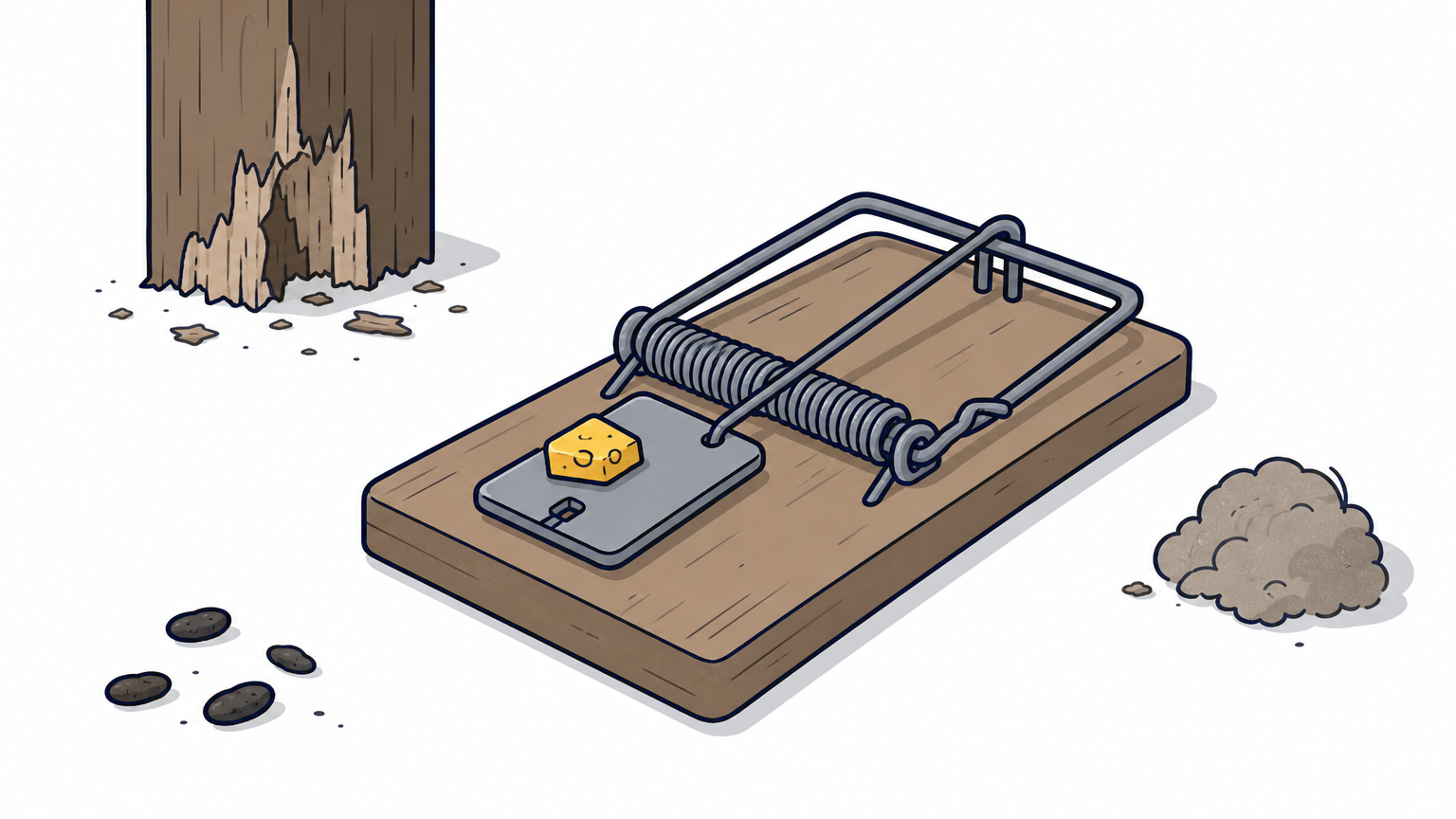
Store-bought traps catch the bold, hungry individuals first, but rats are neophobic, meaning they avoid new objects in their environment for days or weeks. That gives the rest of the colony time to breed while your traps sit untouched. Professional treatment plans account for this behavior, combining exclusion work (sealing gaps as small as a quarter) with placement strategies that target actual travel paths rather than guesswork.
| Approach | Typical result | Why it falls short |
|---|---|---|
| Store-bought snap traps | Catches 1-2 rats | Doesn't address breeding population or entry points |
| Grocery store bait stations | Slow kill, unpredictable | Rats can die inside walls, causing odor issues |
| Sealing gaps yourself | Reduces new entry | Misses hidden points in rooflines, vents, plumbing |
| Professional rat control service | Eliminates colony, seals entry points | Requires hiring a licensed pro |
Skipping a professional often costs more later
Money gets wasted twice when a rat problem is treated as a minor annoyance instead of what it is: an infestation that grows every week it's ignored. Untreated rats gnaw through electrical wiring, PVC piping, and wood framing, and insurance companies frequently deny claims tied to rodent damage since it's classified as a preventable maintenance issue rather than sudden loss. Working with an experienced local pest control company upfront, one that understands how Mesa's irrigation boxes, palm trees, and block wall gaps funnel rats onto residential properties, almost always costs less than repairing chewed wiring or replacing insulation after the fact. If you're already noticing signs of activity, Polite Pest Co.'s home pest control services are built around exactly this kind of targeted rodent work rather than a one-size-fits-all spray-and-go visit.
How to find the right rat exterminator near you
Searching "rat exterminator near me" pulls up a dozen companies in seconds, but a quick search doesn't tell you who actually specializes in rodents versus general pest control that treats rats as an afterthought. Start by vetting rat pest control companies near you and narrowing the list to companies licensed by the Arizona Office of Pest Management, since state licensing confirms the technicians passed exams specific to structural pest control, not just general lawn treatments.
Check for local, rodent-specific experience
Ask how many rat jobs the company handles in your zip code each month, not just how many years they've been in business. A rat control specialist who works Mesa and Gilbert regularly knows which neighborhoods have roof rat pressure from citrus trees and which older homes have gaps around plumbing stacks that generic pest sprayers miss entirely.
A company that inspects before it quotes is worth more than one that quotes before it inspects.
Ask these questions before you sign
A legitimate exterminator answers these without hesitation, and vague or evasive answers are your cue to call the next company on your list.
- Do you inspect the property before giving a price, or quote over the phone?
- What's your plan for sealing entry points, not just placing bait?
- How many follow-up visits are included, and over what timeframe?
- What guarantee do you offer if rats return within that window?
- Are your technicians licensed and insured in Arizona?
Read reviews with a critical eye
Online reviews help, but focus on ones that mention rodent work specifically , not general ant or scorpion treatments. A company can have great reviews for spider control and still do a mediocre job sealing rat entry points, since those are different skill sets. Look for mentions of exclusion work, attic inspections, and follow-up visits in the reviews themselves, since those details tell you more than a star rating ever will.
Finally, get at least two estimates from local exterminators that handle rats before committing, and make sure both companies physically inspect the property rather than pricing based on square footage alone. Prices vary based on infestation severity and property layout, and a company willing to walk your attic and crawl space before quoting is signaling it plans to treat the actual problem, not just sell you a service package. Polite Pest Co. offers free, no-obligation estimates for exactly this reason, so you know what you're paying for before any work starts.
What to expect during a professional rat extermination
Once you've hired a company, the actual process looks nothing like what most people picture when they think of pest control. There's no quick spray-and-leave visit for rodents. A proper rat extermination service unfolds over several weeks, not a single afternoon, because trapping out an established colony and sealing every entry point takes time to do right.
The initial inspection sets the plan
Every legitimate job starts with a technician walking your attic, crawl space, garage, and exterior perimeter to map entry points and nesting sites before touching a single trap. They're looking for grease marks along beams, chew damage on wiring, droppings concentrated in specific corners, and gaps around plumbing stacks, roof vents, and utility lines. This inspection determines the treatment plan, and it's also where you find out how bad the infestation actually is, since droppings alone can't tell you if you're dealing with five rats or fifty.
The inspection matters more than the bait, because you can't seal what you never found.
Exclusion work comes before or alongside trapping
Sealing happens at the same time as trap placement in most cases, not after, since new rats keep entering through open gaps while you're still working on the current population. Technicians use materials like galvanized steel mesh and construction sealant on gaps as small as a quarter, because standard caulk or spray foam gets chewed through within days. Expect your technician to explain exactly which gaps they're closing and why, rather than vaguely mentioning "sealing" without specifics.
Trap placement follows travel paths, not guesswork
Rather than scattering traps randomly, a trained exterminator places them along the actual paths rats use, based on droppings, grease trails, and gnaw marks found during inspection. Here's roughly what a first visit typically includes:
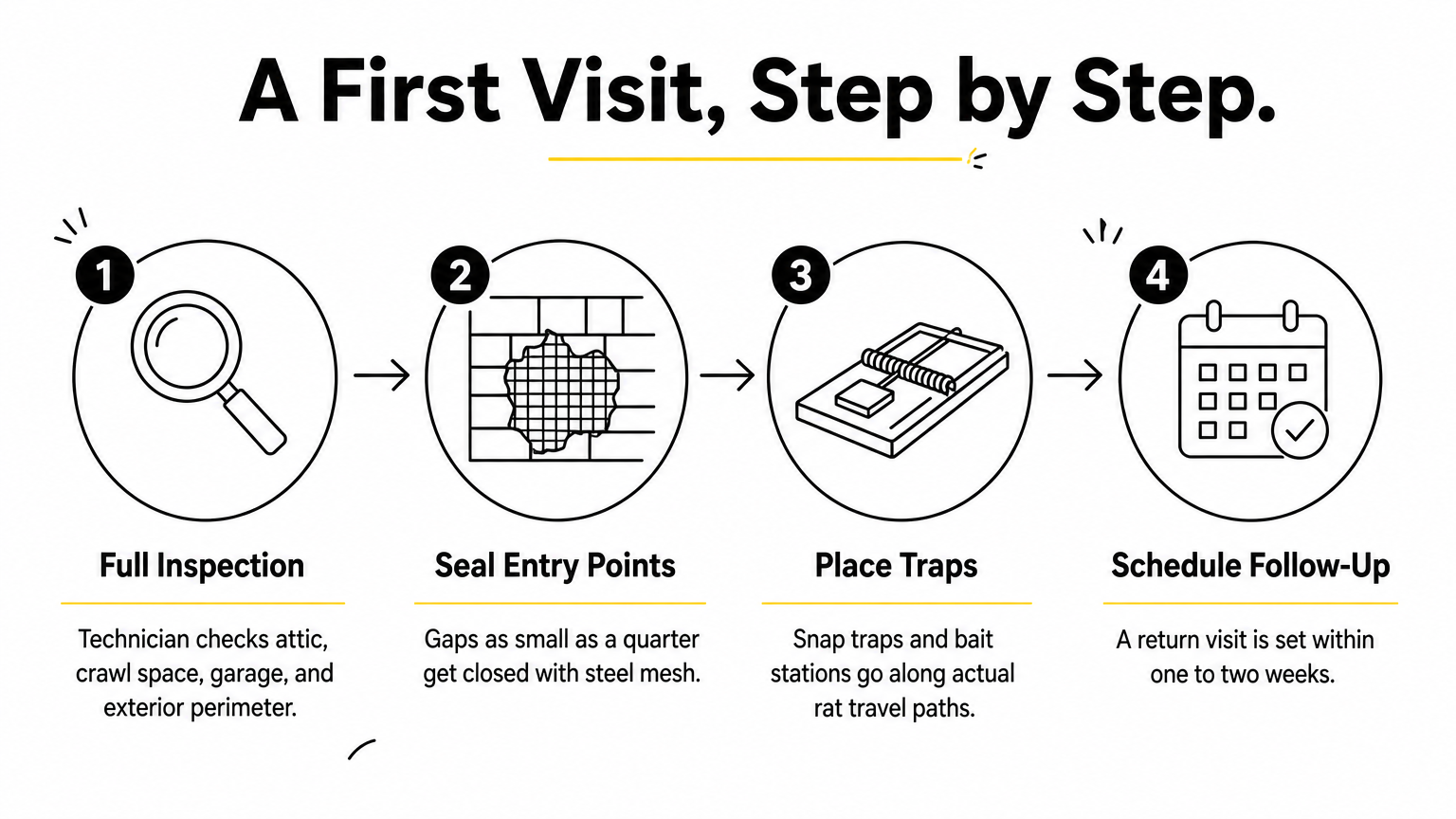
- Full interior and exterior inspection with a written summary of findings
- Sealing of active entry points using rodent-proof materials
- Placement of snap traps or bait stations in attics, crawl spaces, and perimeter zones
- A scheduled follow-up date, usually within one to two weeks
Follow-up visits confirm the job actually worked
Monitoring continues over the following weeks, with technicians checking trap activity, removing carcasses, and adjusting placements as needed. A single visit rarely finishes the job since it takes multiple checks to confirm the colony is gone and no new rats have found a fresh gap. Reputable companies build this follow-up window into the price upfront instead of charging you for each additional visit.
Signs you have a rat problem, not just a rumor
Before you type "rat exterminator near me" into your phone, it helps to know whether you're dealing with an actual infestation or a one-time visitor that wandered in and left. Rats leave behind physical evidence long before you ever see one scurry across a room, and knowing when a rodent problem needs a professional saves you from either overreacting to a single dropping or underreacting to a colony that's already established itself in your attic.
Droppings, grease marks, and gnaw damage
Droppings are the clearest sign, and they tell you more than just "rats are here." Fresh droppings look dark and moist, while old ones turn gray and crumbly, so a pile of both means you've had activity for weeks, not days. Grease marks along baseboards and beams come from the oils in a rat's fur rubbing against surfaces as it travels the same path night after night, and gnaw marks on wiring, wood framing, or plastic piping show up wherever rats have been sharpening their teeth or chewing through a barrier to reach food or nesting material.
One dropping is a warning. A trail of them along a beam means you're already housing a colony.
Sounds, smells, and sightings
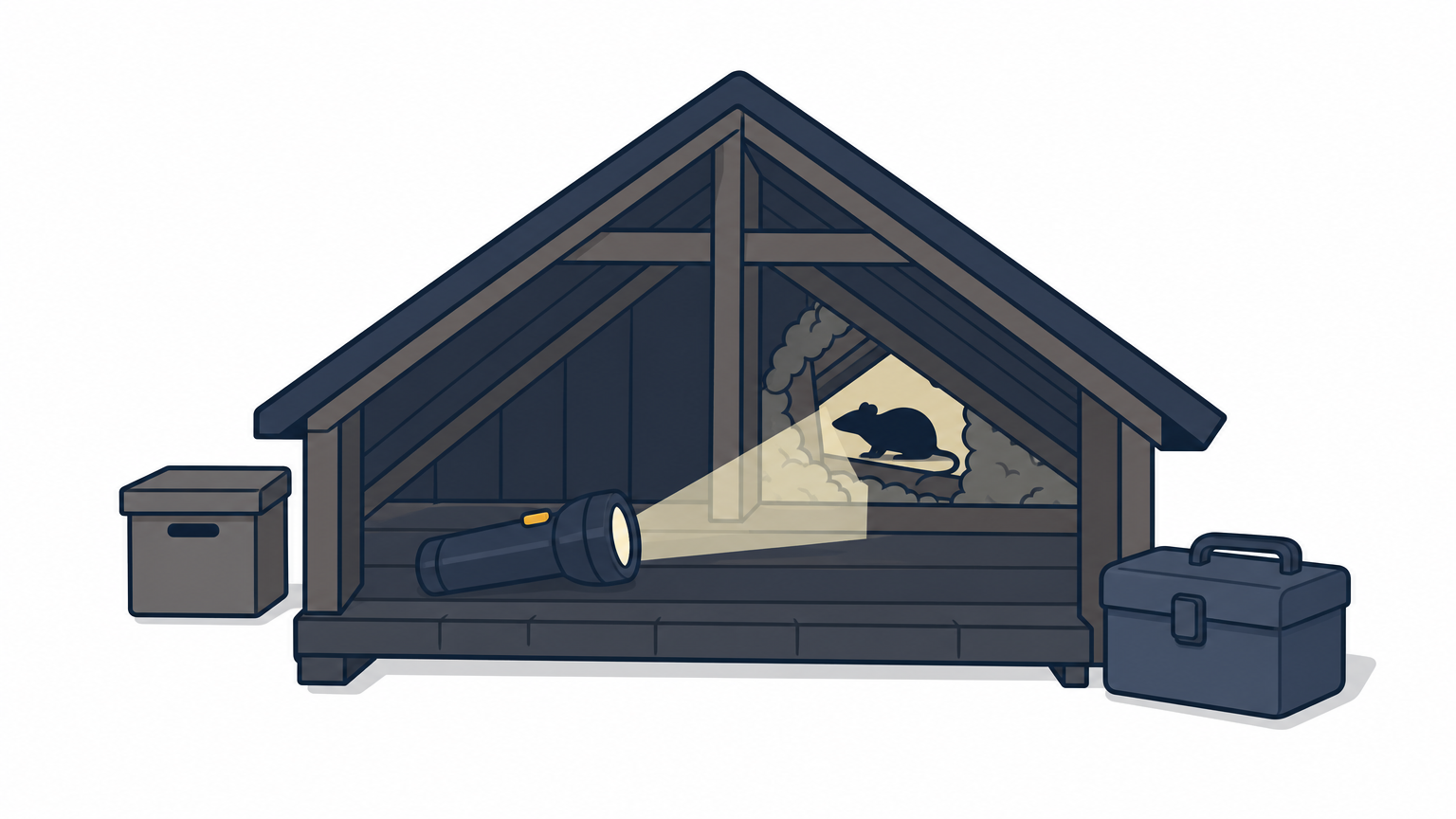
Scratching or scampering in the attic or walls, especially after dark, points to roof rats moving through your ceiling space, since they're most active at night. A persistent ammonia-like smell in an enclosed space like a garage or crawl area usually means urine has accumulated in one spot over time. Actually seeing a rat during the day is a bigger red flag than most homeowners realize, since rats are naturally nocturnal and daytime sightings often mean the population has grown too large for the usual hiding spots.
Run through this quick checklist before calling a rodent exterminator :
- Droppings clustered near food storage, attic insulation, or garage corners
- Grease smudges along walls, beams, or entry points
- Gnaw marks on wiring, baseboards, or stored boxes
- Scratching sounds in walls or ceilings at night
- A persistent musty or ammonia smell in enclosed spaces
- Rat sightings during daylight hours
If you check off two or more of these, you're past the rumor stage and into an active infestation that needs a proper inspection, not just a few traps set out on your own.
What affects the cost of rat extermination
Every homeowner searching exterminator rats near me eventually asks the same question: what's this actually going to cost? The honest answer is that rat extermination pricing varies more than most pest control services because the scope of work depends entirely on what a technician finds during inspection, not a flat per-visit rate. A single mouse in the garage costs far less to resolve than a roof rat colony that's been nesting in your attic insulation for months, though hiring a local mouse exterminator follows the same vetting rules.
Property size and infestation severity drive the baseline
Larger homes simply have more linear feet of roofline, more vents, and more potential entry points to seal, which raises both labor time and material costs. Severity matters just as much as square footage, since a light infestation might need one round of trapping and a few sealed gaps, while an established colony requires multiple follow-up visits, more trap stations, and sometimes attic sanitation to remove contaminated insulation.
The price tag follows the infestation, not the address, so two identical houses can get very different quotes.
Exclusion work adds cost but saves money later
Sealing entry points with galvanized steel mesh and proper sealant takes more time than simply setting bait, and that labor shows up in the estimate. Skipping this step keeps the quote lower upfront, but it also guarantees new rats find the same gaps within months, meaning you pay for another round of treatment anyway.
Recurring plans versus one-time treatment
Rodent problems in the Phoenix area rarely stay solved with a single visit, which is why most companies price rat work as a treatment package rather than a one-time fee. Here's roughly how the pricing structure typically breaks down:
| Cost factor | Impact on price |
|---|---|
| Property size and number of entry points | More gaps to seal, higher labor cost |
| Infestation severity | Larger colonies need more trap visits |
| Exclusion materials used | Steel mesh and sealant cost more than bait alone |
| Number of follow-up visits | Bundled follow-ups usually cost less than pay-per-visit |
| Attic or crawl space sanitation | Adds cost but removes contaminated insulation |
Bundling a recurring pest control plan with rat treatment often costs less over a year than paying for isolated visits every time activity returns, since ongoing monitoring catches new entry points before they turn into another full infestation. Polite Pest Co. builds pest control plans around this exact logic, pricing based on your property rather than a generic flat rate.
Keeping rats out for good
Rats don't leave on their own, and a few traps from the hardware store rarely finish what an established colony has started. The real fix combines thorough inspection , exclusion work that seals every gap a rat can squeeze through, and follow-up visits that confirm nothing survived. Skip any of those three steps and you're just buying time before the scratching starts again.
Searching exterminator rats near me got you this far, but hiring the right pro is what actually solves the problem. Ask the questions from this guide, check for rodent-specific reviews, and pick a company that inspects before it quotes. If you're in Mesa, Chandler, Gilbert, Queen Creek, Phoenix, or Scottsdale and ready to stop guessing, get a free rodent control estimate from Polite Pest Co. and have a technician map your property's actual risk before rats settle in for another season.