

Commercial Pest Control: What It Is and Why Your Business Needs It
One health inspector visit or a customer spotting a roach can undo years of building trust in your business. That's the reality for property owners across Mesa, Gilbert, Chandler, and the greater Phoenix area, where desert pests like scorpions, ants, and rodents don't care whether you run a restaurant, office, or retail store. Pest control for commercial properties exists specifically to handle these risks before they turn into lost customers or failed inspections.
So what actually counts as commercial pest control, and why does your business need it instead of a one-time spray? At its core, commercial pest control services involve scheduled inspections, targeted treatments, and prevention plans built around your specific property, industry, and foot traffic, not a generic residential approach. Businesses need this level of protection because pest problems in commercial settings carry legal, financial, and reputational consequences that homeowners simply don't face.
This article breaks down exactly what commercial pest control covers, how it differs from residential service, and what to expect when you search for pest control commercial near me in the Phoenix metro area. You'll walk away knowing what a solid service plan looks like and why recurring protection matters more than a single treatment.
Why commercial pest control matters for your business
Health code violations don't wait for a slow season. In Arizona, restaurants, grocery stores, and food processing facilities face inspections from Maricopa County Environmental Services, and evidence of rodents, cockroaches, or stored product pests can trigger fines, forced closures, or a public write-up that follows your business online for years. Commercial pest control services exist to keep you ahead of that inspector, not scrambling after a bad report.

Beyond the legal exposure, there's the reputation problem. A single customer photo of a scorpion near the register or an ant trail across a counter can spread faster than any marketing campaign you've paid for. Pest control commercial clients often tell us the same thing: one bad review mentioning pests does more damage than months of good service can undo. Retail stores, medical offices, warehouses, and hospitality businesses all carry this same risk, just with different stakes attached.
A single pest sighting can cost you more customers than a month of bad reviews ever will.
Money matters here too, and not just in fines. Untreated infestations damage inventory, chew through wiring, and force emergency closures that cost far more than a recurring service plan ever would. Consider how the risks stack up depending on how you approach pest management:
| Approach | Typical Cost | Business Risk |
|---|---|---|
| No pest control | $0 upfront | High risk of infestation, fines, closures |
| One-time treatment | $150 to $400 per visit | Short-term fix, pests often return |
| Recurring commercial plan | Monthly or bimonthly rate based on property size | Continuous protection, documented compliance |
Since desert climates like Phoenix and Mesa push scorpions, rodents, and ants indoors seeking water and shade, businesses here face pest pressure that many other regions simply don't deal with. That regional reality is exactly why commercial pest control services built for the Southwest look different from a national franchise's generic template. A plan designed around monsoon season ant swarms or winter rodent migration into warehouses does more for you than a one-size-fits-all schedule.
Trust also plays a role that's easy to underestimate. Employees notice when ownership takes pest management seriously, and so do commercial tenants leasing space in a shared building. Vendors and business partners walking through your facility form impressions fast, and a visible pest problem undercuts every other investment you've made in your space. That's the kind of first impression you don't get to redo.
Ultimately, the case for professional pest management comes down to control. When you outsource this to a licensed provider like Polite Pest Co.'s Mesa commercial pest management team, you get documented treatments, compliance-ready records, and a team that understands what health inspectors and customers alike expect from a business in Mesa or the greater Phoenix area. Waiting until you see a pest is waiting too long, because by then the damage to your reputation, inventory, or inspection record has already started.
How commercial pest control services work
A solid commercial pest control program starts with an inspection, not a spray. Technicians walk your entire property, inside and out, looking for entry points, moisture sources, and signs of activity you'd never spot on your own. Pest control commercial services built around this initial assessment let a provider map out where scorpions squeeze through door sweeps or where rodents are gnawing into a stockroom, so the treatment plan actually targets your risks instead of guessing.
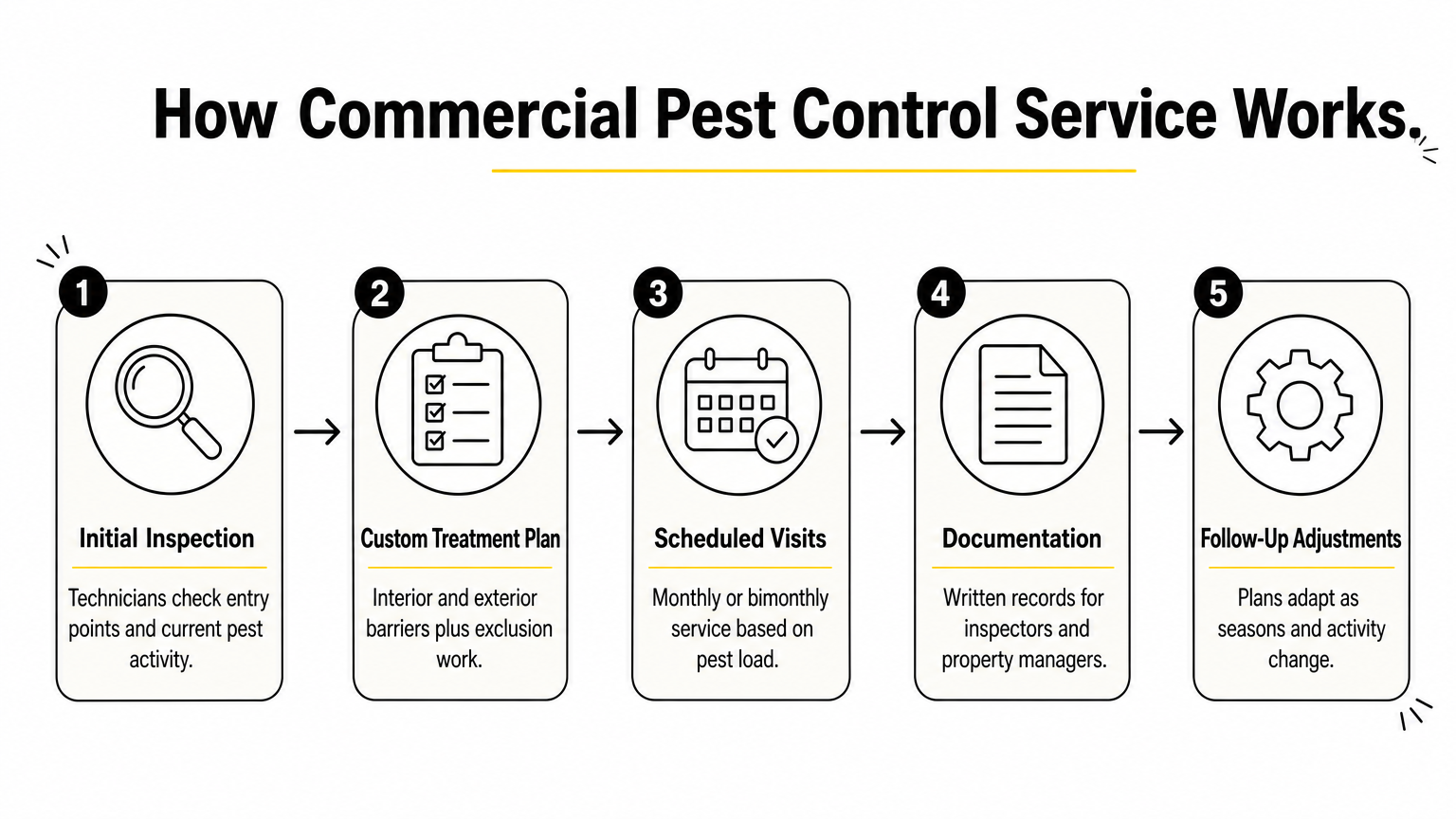
Once that assessment is done, the provider builds a treatment schedule matched to your property size, industry, and pest pressure. Restaurants need different frequency than a warehouse or a medical office, and Arizona's seasonal shifts change what's active month to month. Here's roughly how the process unfolds for most Mesa and Phoenix-area businesses:
- Initial inspection to identify entry points, conducive conditions, and current pest activity.
- Custom treatment plan covering interior and exterior barriers, bait stations, and exclusion work.
- Scheduled service visits , typically monthly or bimonthly depending on your industry and pest load.
- Documentation after every visit, giving you records for health inspectors or property managers.
- Follow-up adjustments as seasons change or new activity shows up between visits.
Consistent service beats a single big treatment every time, because pests keep coming back until the conditions that invite them are gone.
Documentation matters more in commercial settings than most owners expect going in. Every visit generates a service report showing what was treated, what was found, and what products were used, which becomes your paper trail if a health inspector asks for proof of active pest management. Grocery stores, food processing plants, and hospitality businesses lean on these records constantly, since Maricopa County inspectors expect to see them on demand.
Inside that recurring structure, providers also adjust for what's happening around your building. Landscaping, dumpsters, standing water, and even neighboring businesses all influence pest pressure, so a technician who knows your property will flag conducive conditions before they turn into an infestation. That's the real difference between a one-time spray and an actual commercial pest control program built to hold up over time.
Pests and industries commercial pest control covers
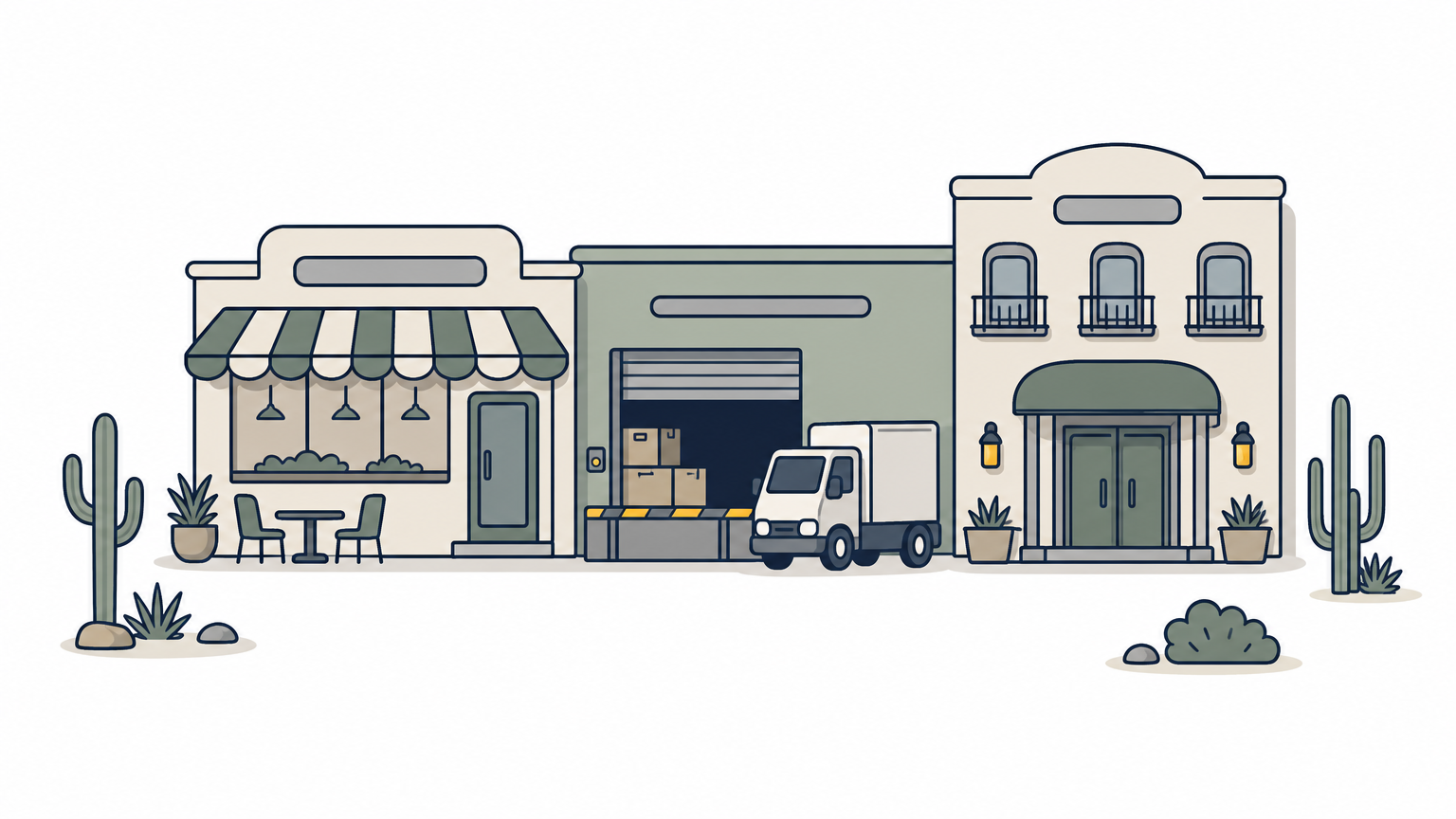
Different businesses attract different pests, and a Mesa restaurant deals with a completely different pressure than a warehouse that needs bug extermination in Chandler or a Scottsdale medical office. Commercial pest control services account for that variation instead of running the same treatment across every property type. Ants and cockroaches chase food sources in kitchens and break rooms, while rodents target storage areas, warehouses, and anywhere cardboard or insulation gives them nesting material, which is where rodent trapping and exclusion work comes in.
Given Arizona's climate, bark scorpion extermination deserves special mention. They slip through gaps as thin as a credit card and show up in retail stockrooms, hotel guest rooms, and office break areas across the Phoenix metro. Bed bug infestations hit hospitality businesses hardest, since a single guest complaint about bites can trigger review-site damage that lingers for months. Bees present a different kind of risk entirely, since a hive near an entrance turns into a liability issue the moment a customer or employee gets stung, and hive removal becomes urgent.
The pests threatening a restaurant, a warehouse, and a hotel are rarely the same, and your treatment plan shouldn't be either.
Here's how pest pressure typically breaks down by industry across Mesa, Gilbert, and the surrounding area:
| Industry | Common Pests | Primary Concern |
|---|---|---|
| Restaurants and food service | Cockroaches, ants, rodents | Health code violations, inventory loss |
| Warehouses and storage | Rodents, spiders, gophers | Structural damage, product contamination |
| Hotels and hospitality | Bed bugs, scorpions | Guest complaints, online reviews |
| Retail stores | Ants, spiders, scorpions | Customer safety, brand image |
| Medical and office buildings | German roaches, rodents | Compliance, employee wellbeing |
Office buildings and medical facilities carry their own compliance pressure, since German roaches multiply fast in break rooms and can trigger complaints from tenants sharing the same building, which makes targeted roach extermination a priority. Property managers overseeing multi-tenant spaces often need business exterminators in Gilbert and similar commercial coverage across an entire complex, not just one unit, since pests rarely respect lease boundaries. Weed removal service around parking lots and walkways rounds out the list for many commercial clients, since overgrown landscaping creates the exact conditions rodents and insects use to approach your building undetected. Matching the treatment to your specific industry, rather than applying a blanket approach, is what separates a provider that understands commercial risk from one that's just repeating a residential playbook.
How to choose the right commercial pest control provider
Not every provider that shows up on a search for pest control commercial near me understands what a business actually needs. Some companies just run residential routes with a commercial label slapped on top, which shows up fast once you ask about documentation, licensing, or industry-specific treatment. Picking the right partner means checking credentials before you check price.
Licensing, insurance, and experience
Arizona requires pest control businesses to hold a license through the Arizona Department of Agriculture, so ask for that number before signing anything. Commercial pest control work also carries liability exposure, since technicians work around food prep areas, guest rooms, and employee spaces, so confirm the provider carries adequate insurance. Experience with your specific industry matters just as much: a company that's serviced restaurants and warehouses across Mesa and Chandler will spot risks a residential-focused technician misses entirely.
A provider without proper licensing and commercial experience is a liability, not a solution.
What to ask before you sign
Use this checklist when comparing commercial pest control services for your property:
- Do they provide detailed service reports after every visit?
- Can they show experience with your specific industry (restaurant, warehouse, retail, hospitality)?
- Do they offer flexible scheduling around your business hours?
- Is pricing based on property size, or a flat rate that ignores your actual risk?
- Do they guarantee follow-up visits if pests return between scheduled services?
Local knowledge beats national franchises
Questions aside, local expertise still tips the scale. A provider based in the Phoenix metro understands monsoon-driven ant swarms, winter rodent migration, and the scorpion pressure unique to this desert climate, none of which a national franchise's generic template accounts for. Reliability also shows up in response time: when a scorpion turns up in a stockroom or a guest complains about bed bugs, you need a technician on-site fast, not routed through a call center. Weighing these factors together, rather than defaulting to the first name in search results, is what separates a provider who protects your business from one who just fills a schedule.
Keeping your business pest-free year-round
Protecting a business from pests isn't a one-time task, it's an ongoing commitment that pays for itself in avoided fines, saved inventory, and a reputation that stays intact. Commercial pest control works because it catches problems before customers or inspectors ever see them, and that consistency is exactly what separates a professional plan from a reactive scramble. Mesa and Phoenix-area businesses face pest pressure that shifts with the seasons, so a provider who understands monsoon ant swarms and winter rodent migration will always outperform a generic template.
Given what's at stake, waiting for a sighting before you act is the costliest mistake a property owner can make. Handling this proactively, with a licensed, local team that knows your industry, keeps your business compliant and your customers confident. If you're ready to protect your property with a plan built around your actual risks, request a free commercial pest control estimate from Polite Pest Co. and start recurring service before pests find their way in.