

Price for Termite Treatment: What You Should Expect to Pay
You spotted mud tubes near your foundation or wings on the windowsill, and now you're bracing for a bill you can't predict. The price for termite treatment varies more than most homeowners expect, and getting a quote without context makes it hard to know if you're paying a fair rate or getting overcharged for a problem that's stressing you out.
Most homes in the Phoenix area pay between $400 and $2,500 for termite treatment, depending on infestation severity, treatment method, and square footage. National chains like Terminix or Orkin often price differently than local companies, and per-square-foot rates typically run from $3 to $16, with subterranean termite jobs on the higher end because of the labor involved in trenching and drilling around a foundation.
In this article, we'll break down what drives those numbers up or down, compare treatment types so you understand what you're actually paying for, and show you what a realistic quote looks like for a Mesa or Phoenix-area home. By the end, you'll know exactly what questions to ask before signing anything.
Why termite treatment prices vary so widely
Ask five pest control companies for a termite treatment cost and you'll likely get five different numbers, and that's not because anyone's padding the bill. Termite jobs are priced around the specific conditions at your property, not a flat menu rate, so the same house could see a $500 quote from one technician and a $1,800 quote from another depending on what they find during inspection.
Infestation severity and termite species
Drywood termites living in a single wall section cost far less to treat than a full subterranean colony tunneling under your slab. Subterranean termites, the dominant species across Arizona, require more aggressive treatment because they nest in soil and can spread to multiple structures on a property, which drives up both labor and material costs.
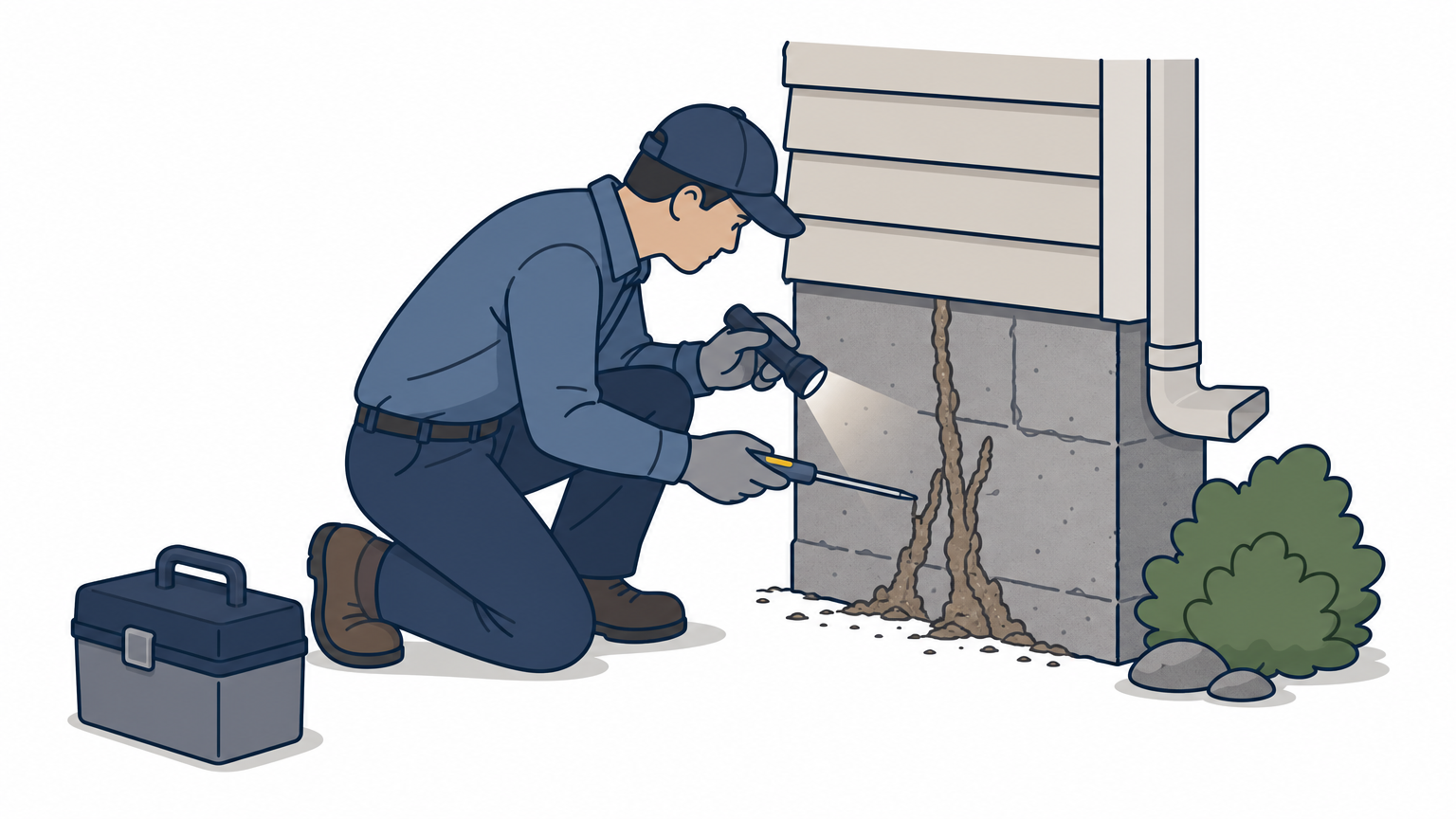
A termite quote reflects the size of the colony problem, not just the size of your house.
Home size and construction type
Square footage matters, but so does foundation type. Slab homes typically need drilling and trenching around the entire perimeter, while homes with crawl spaces allow easier access and lower labor time.
| Factor | Impact on Price |
|---|---|
| Termite species | Subterranean costs more than drywood |
| Infestation size | Localized spot treatment vs. whole-structure |
| Foundation type | Slab requires more drilling than crawl space |
| Accessibility | Additions or landscaping add labor time |
Provider overhead and warranty terms
National brands carry higher overhead from marketing and franchise fees, which shows up in their termite treatment pricing even when the actual work is comparable to a local company. Warranty length also factors in, since a company backing its work for five years prices differently than one offering a one-year guarantee.
How to get an accurate termite treatment quote
Getting a number you can trust starts with an actual inspection, not a phone estimate. Any company willing to quote a termite treatment price without stepping foot in your crawl space or attic is guessing, and that guess can swing wildly once they discover the real extent of the damage.
What a proper inspection includes
A thorough technician checks the foundation perimeter, attic framing, plumbing penetrations, and any wood-to-soil contact points around the yard. They'll identify the species, map the likely colony location, and note construction details like slab versus crawl space that affect labor. Skip this step and you're just paying for a rough guess dressed up as a quote.
The only quote worth trusting is one written after someone has walked your property.
Questions to ask before you sign
- Is this quote based on a full inspection or a phone estimate?
- What treatment method are you recommending, and why?
- Does the price include a warranty, and how long does it last?
- Are follow-up visits or retreatments included in the cost for termite treatment ?
- What happens if termites return within the warranty period?
Get at least two written quotes before deciding. Comparing them side by side reveals whether a price reflects real work or padding.
Termite treatment costs by method
Liquid soil treatment remains the standard for professional termite treatment in Mesa, with termite treatment costs typically running $5 to $12 per linear foot around your foundation. Technicians trench and treat the soil with a non-repellent chemical, creating a barrier termites can't detect until they've carried it back to the colony.
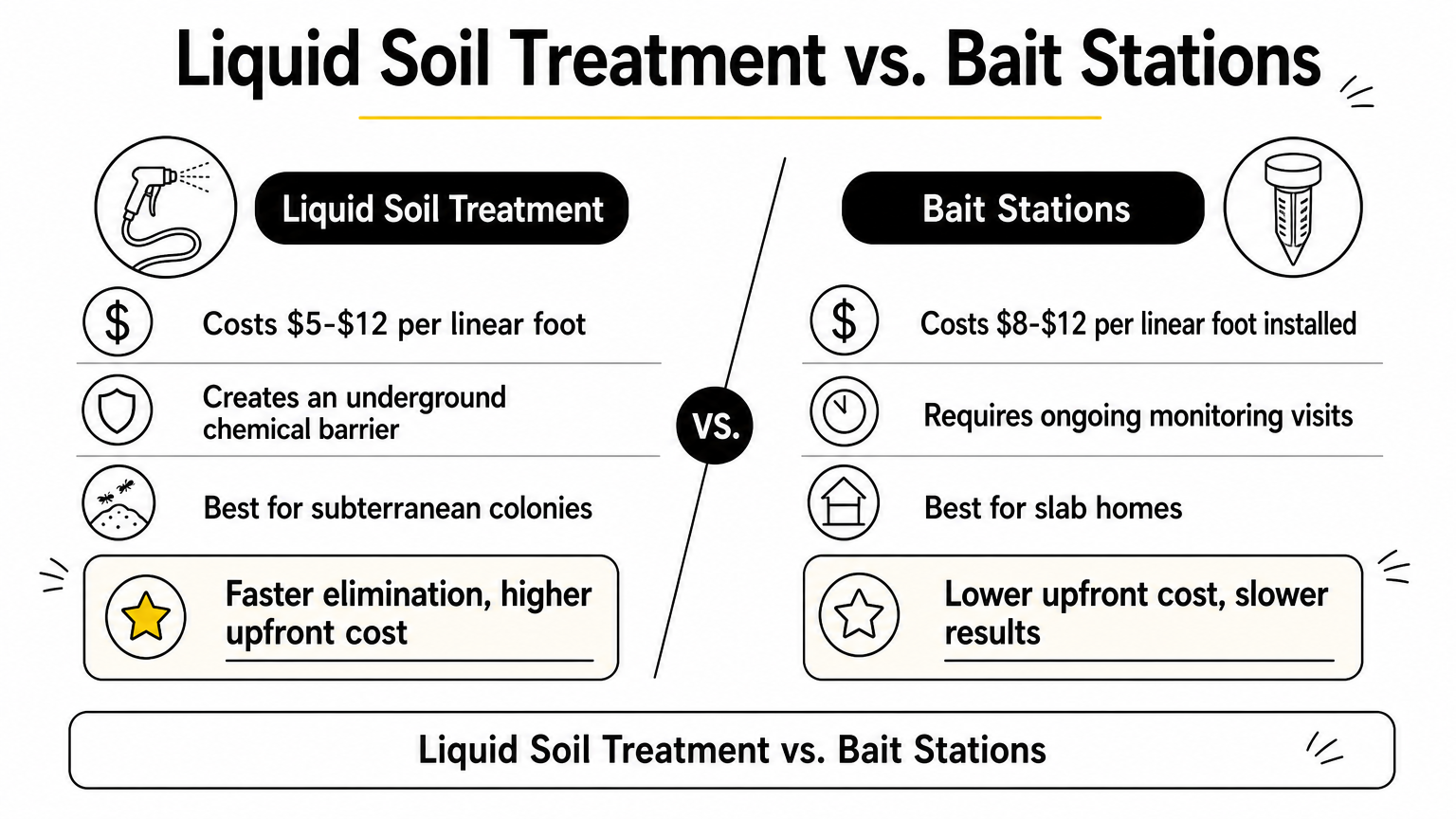
Bait stations offer a lower upfront cost but require ongoing monitoring, usually priced between $8 and $12 per linear foot installed, plus a service fee every few months to check activity. This method works well for slab homes where trenching isn't practical, though it takes longer to eliminate a colony compared to liquid treatment.
Cheaper upfront doesn't always mean cheaper overall once you factor in monitoring visits.
Fumigation, reserved for severe drywood infestations, costs the most: often $1,200 to $2,500 for a full tent job, since it requires tenting the entire structure and relocating occupants for a few days.
| Method | Typical Price Range | Best For |
|---|---|---|
| Liquid soil treatment | $5-$12/linear ft | Subterranean colonies |
| Bait stations | $8-$12/linear ft + monitoring | Slab homes, ongoing prevention |
| Fumigation | $1,200-$2,500 total | Severe drywood infestations |
Monthly and yearly termite protection costs
Once the initial treatment is done, ongoing protection keeps new colonies from moving in. Most Phoenix-area companies offer annual renewal plans for termite treatment cost management, running $300 to $700 per year depending on home size and whether bait stations need refilling or monitoring visits. This yearly fee usually covers a scheduled inspection plus retreatment if activity shows up, so you're not paying full price again if termites return.

Some homeowners prefer monthly billing instead of one lump annual payment. Monthly plans typically break down to $25 to $60, which covers the same inspection and retreatment coverage just spread across smaller payments. Either option beats paying for a full new treatment because you skipped a renewal and let a colony re-establish itself.
Skipping the annual renewal to save a few hundred dollars usually costs you thousands later.
Questioning whether a warranty renewal is worth it? Ask what triggers a free retreatment versus a new charge. A properly written plan should cover reinfestation at no extra cost, not just an inspection with a bill attached if termites show up again. Our termite control and prevention plans spell out exactly what's included before you sign anything.
What termite treatment costs in the Phoenix area
Local soil conditions push Phoenix pricing in a specific direction, on top of the termite risk Phoenix homeowners already live with. Caliche, the hard clay layer under much of Mesa and Chandler, slows down trenching work, so termite treatment costs here often land at the higher end of the national range even for a mid-sized home. A typical 1,800 to 2,500 square foot slab home in Mesa or Gilbert termite treatment service area runs $800 to $1,600 for liquid soil treatment, while a comparable job with bait stations lands closer to $1,000 to $1,800 once installation and the first year of monitoring are included.
Queen Creek and outer Chandler properties on larger lots sometimes see higher perimeter costs simply because there's more foundation to treat. Scottsdale homes with older construction and additions built over decades often need extra trenching around each addition, which adds to the cost of termite treatment beyond what a newer Phoenix build would require.
Ask any Mesa-area company for a price and expect the caliche layer to factor into the number.
Getting a free termite inspection before committing tells you which side of that range your home falls on.
Making sense of your termite treatment quote
A fair price for termite treatment always ties back to what a technician actually found on your property, not a generic per-square-foot number pulled from a brochure. Now that you know the ranges for liquid treatment, bait stations, and fumigation, you can spot a quote that's padded versus one that reflects real labor and materials. Before you sign anything, compare at least two written estimates, confirm what triggers a free retreatment, and make sure the warranty terms match what you're paying for.
Getting the number right matters less than getting the colony gone for good. Trust builds when a company shows up, inspects thoroughly, and explains every line item instead of rushing you to a signature. If you're ready to see where your Mesa or Phoenix-area home falls, request a free termite treatment quote from Polite Pest Co. and get a number you can actually understand.